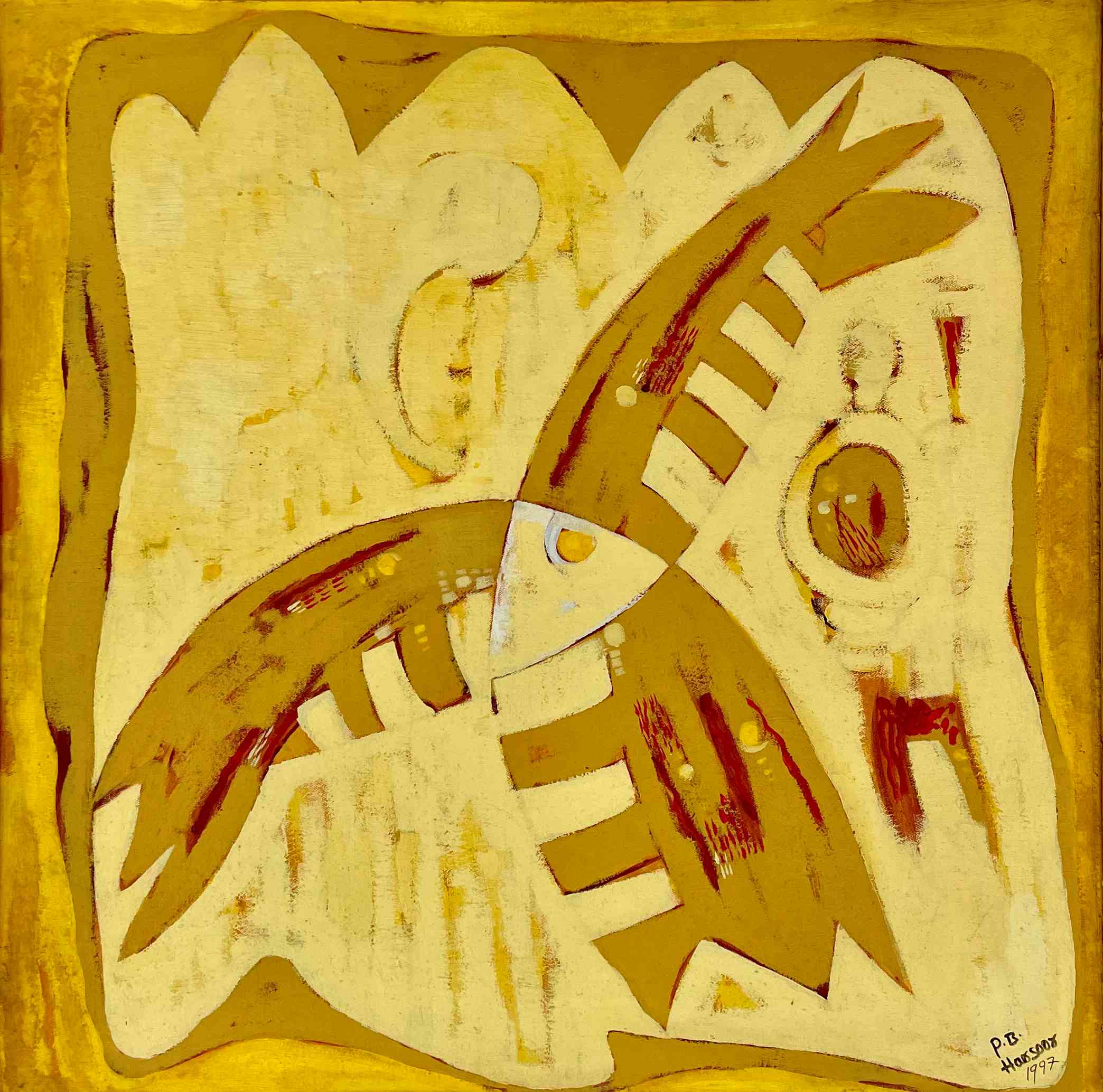
Oil on Canvas
|
24 x 24 inches
Stand in front of a Prabhu Harsoor canvas, and you feel like you almost know it. The shapes look like letters. Then they look like faces, or gods, or something your grandmother might have said. You're at the edge of a language that hasn't happened yet, and you can't quite read it.
Colour and brushwork come later. The first thing you notice is that strange, half-familiar feeling.
Harsoor was born in 1962 and trained the traditional way. He earned a Diploma in Fine Arts from The Ideal Fine Arts Institute in Gulbarga, then a Master's in Visual Arts from Karnataka University in Hampi. What he did with that training is anything but textbook.
His work lives in the gap between abstraction and figures. He's often compared to Vasudeo Gaitonde, and you can see why. Both treat the canvas like a place where alphabets are still being invented. But Harsoor takes it somewhere more personal.
Memory, script, and the folk imagery of Karnataka bleed into each other until you can't tell where one ends and the next begins. Some of his marks look like a word on the tip of your tongue that never lands.
Look closer, and a lot is going on in there. He draws on temple iconography, inscribed tablets, folk motifs, and the careful geometry of the yantra. These aren't decoration. They work more like diagrams, things you're meant to engage with, not just glance at.
He works in ink, pigment, and graphite as well as paint, so the surfaces feel layered, like marks written over older marks.
Then there's the grid. In his hands, it's more than a way to organise a canvas. It reads like a perfectly well-designed map of how society is built: caste, labour, cities changing shape around the people in them. Next to it you'll find eyes that don't blink, masks, musical instruments, and patterns that could be roots or constellations. It's the essence of a place, showing up in different shapes.
Many of his pieces carry Kannada inscriptions, dates, and references to real events. A train accident during the pandemic is one. Rural families moving toward the edges of cities is another.
So this isn't just art floating above life. It remembers things, and it asks you to remember them too. His art reflects life, and life inspires his art.
Political undertones run through his work as well, including quiet nods to the leaders who pushed back against fundamentalism in Karnataka.
This is the thinking behind Grids, Glyphs and Genii, the show curated by Satyajit Dave at Shridharani Gallery, Triveni Kala Sangam, New Delhi, in August 2025. The title is really a map of his practice. Grid, glyph and genius loci. Structure, sign and spirit.
Recognition came steadily, not overnight. Lalit Kala Akademi camps in Delhi and Bangalore. Shows across India and abroad. Gallerie Splash has exhibited his work in Delhi, and honestly, seeing the pieces in person changes things. The texture doesn't survive a screen.
He's a teacher too, at Ravindra Kalaniketan, College of Visual Arts in Tumkur. And the two roles feed each other. Ideas that start in the classroom grow into drawings meant to be sat with, not rushed past. That matters, because Harsoor works slowly in a world that doesn't. His pieces ask you to stay a while.
Don't expect a tidy answer either. His diagrams aren't conclusions. They're closer to invitations.
That's the thread through four decades of work. A man chasing the moment before meaning arrives, one invented alphabet at a time. Still painting. Still teaching. Still building a language nobody else speaks yet.