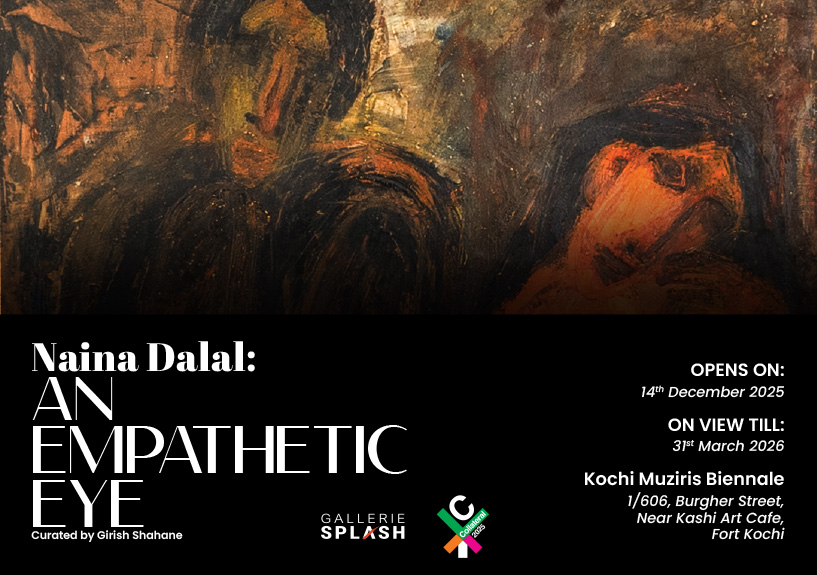
Naina Dalal: An Empathetic Eye
Covering three decades and three mediums, the display of paintings and prints by Naina Dalal in Kochi follows on from a survey of her work at Travancore House in Delhi in September 2024 and a larger retrospective at the National Gallery of Modern Art, Mumbai, in September 2025.
Naina Dalal, who studied painting at the Fine Arts Faculty of M.S. University, Baroda, in the 1950s, produced a substantial body of canvases in the course of a career spanning six decades. An Empathetic Eye features a suite of textured oils made in the 1960s, which spotlight her status as one of the first Indian women artists to explore the nude. These paintings introduce the abiding affect of her work, that of karuna, or pathos grounded in compassion.
In the 1970s, Dalal began creating small-format wash paintings in ink and watercolour exploring themes of motherhood, ageing, and the relationship of humans to animals and to nature. They were rarely exhibited, perhaps from a fear they would be dismissed as trivial, but the delicately translucent compositions have withstood the test of time, feeling as fresh today as they did when they were made.
Dalal’s training as a printmaker began in the early 1960s in London through a course in lithography, and developed further in New York where she studied etching. In the 1980s, working out of her home in Baroda and troubled by toxic materials used in traditional printmaking, she began exploring collagraphy, a process sometimes disparaged for its relative ease of execution. Her collagraphs advance the expressive possibilities of the medium, putting it unquestionably on par with more esteemed forms of printmaking. While her achievements in lithography and etching are substantial, her collagraphs stand out as perhaps the most original aspect of her oeuvre.
The past two decades have witnessed a concerted effort to diversify histories of global modernism, countering the narrow Eurocentricity of earlier analyses. Within India, there is now a widespread acknowledgement that accounts of Indian modernism suffer from an analogous narrowness. The revival of interest in artists like Naina Dalal, now 90 years old, is part of a larger movement to broaden our understanding of twentieth century Indian art.
Works

