Some artists speak through scale. Naina Dalal speaks through proximity. Her images do not shout, they stay. Across drawings, paintings, and a formidable printmaking practice, Dalal has built a language that is emotionally exact and formally disciplined, attentive to the inner lives of women and to the quiet intensity of everyday experience.
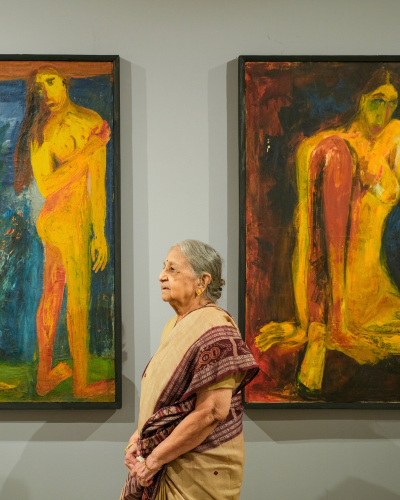
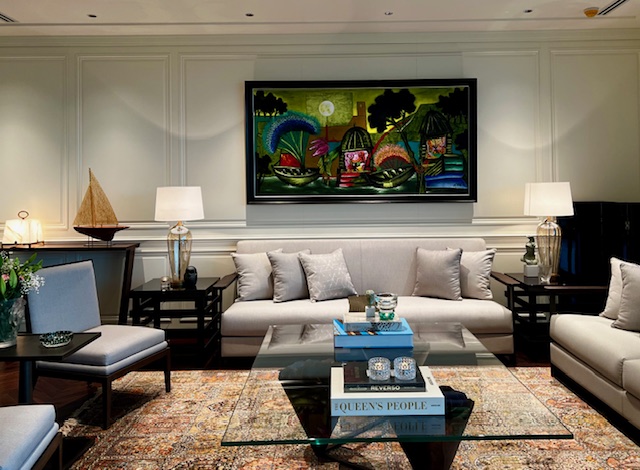
Naina Dalal at Solitary Companions, Travancore Palace
Dalal’s works often begin with the figure, but they never end there. A posture can hold a history. A room can carry a social reality. A single repeated gesture can become a collective condition. Her practice is rooted in technical command, yet it is always guided by empathy. In printmaking especially, line and texture become more than style, they become testimony. Etching, aquatint, collagraphy, and lithography allow her to build an atmosphere with restraint, where what is left unsaid feels as present as what is shown.
This psychological weight is one of the defining strengths of her work. It is also what makes it so contemporary, even when the image belongs to a different decade.
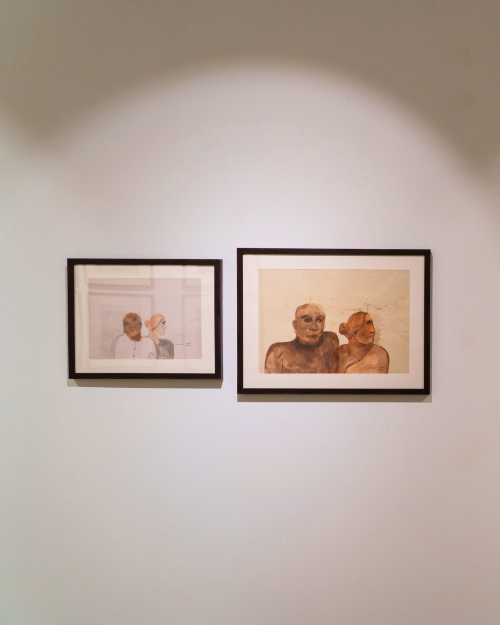
@galleriesplash
Dalal has consistently returned to the textures of life that are often overlooked: silence, waiting, solitude, care, resilience, grief, and the slow pressure of social structures on personal freedom. Her world is intimate, but it is never small.
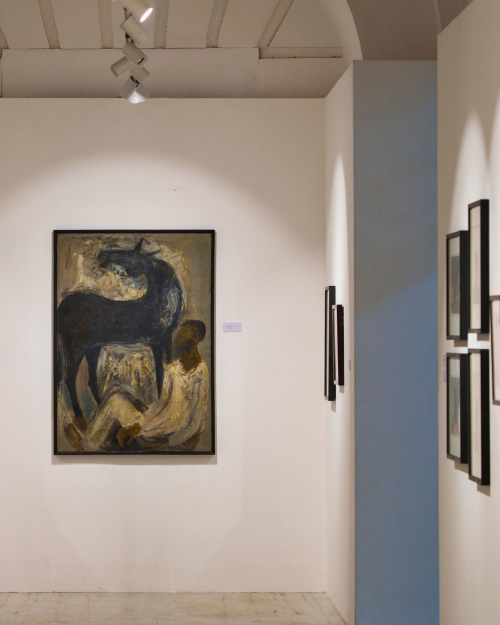
Naina Dalal painting display at Travancore Palace, New Delhi, (from solitary companions)
At Gallerie Splash, our engagement with Naina Dalal has been shaped by this belief in her significance, not only as a pioneering woman artist, but also as an essential voice within Indian modernism. In recent years, this relationship has taken the form of research-led presentations that invite viewers to see the arc of her practice with clarity.
In September 2024, Gallerie Splash presented Naina Dalal: Solitary Companions in New Delhi, curated by Girish Shahane. That exhibition offered a concentrated look at the interiority that runs through her prints and paintings, a sensibility where compassion can dominate the mood, and where, at moments, rage can surface with startling force.
In 2025, her work was brought into sharper public focus through a major institutional presentation at NGMA Mumbai, a landmark moment in recognizing the depth and range of her oeuvre.
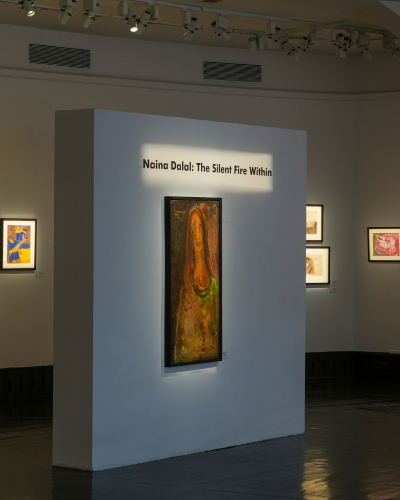
Naina Dalal Display at NGMA, Pic Courtsey Gallerie Splash
This trajectory continues in Kochi, where Gallerie Splash presents Naina Dalal: An Empathetic Eye as a collateral project during the Kochi-Muziris Biennale (14 December 2025 to 31 March 2026), again curated by Girish Shahane. Spanning decades and mediums, the Kochi presentation offers a vivid encounter with Dalal’s ability to move between paint and print while remaining unmistakably herself.
Next, we look forward to the upcoming India Art Fair in New Delhi (5 to 8 February 2026), where Gallerie Splash will continue to bring Dalal’s work to new audiences and collectors in dialogue with the wider contemporary art landscape.
Alongside these exhibitions, Gallerie Splash is producing a dedicated publication on Naina Dalal, conceived as both scholarship and celebration. Importantly, the book is also a chorus. It gathers voices of artists, curators, and writers who have engaged closely with Dalal’s practice, offering readers a textured way into her world.
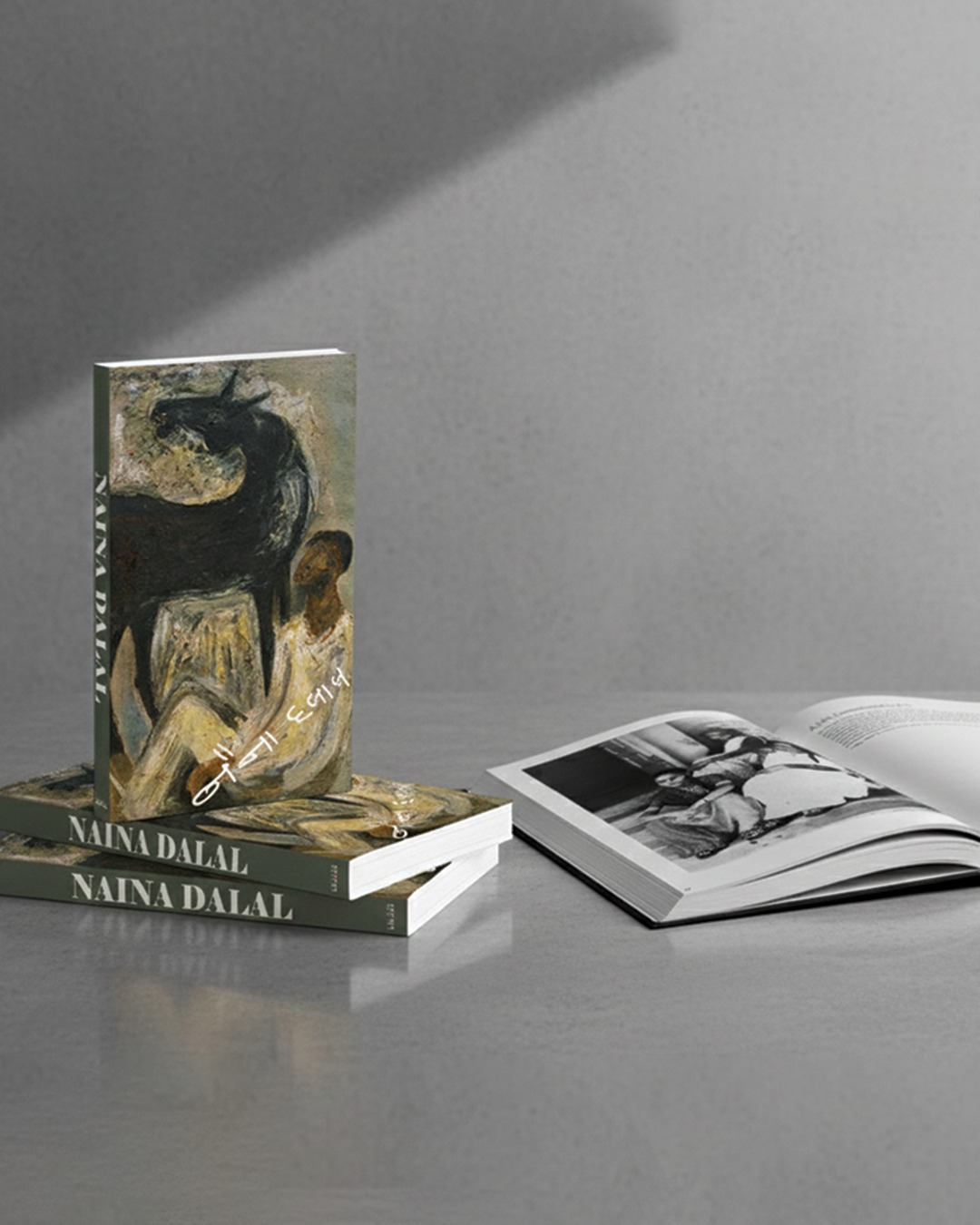
Image from the Book : Naina Dalal Seven decades in Image and Imagination
A particularly resonant text comes from Roobina Karode, Director and Chief Curator of the Kiran Nadar Museum of Art (KNMA). She writes about Dalal’s “woman-centered world,” where figures inhabit moments of silent introspection, alienation, angst, and pain. Karode draws attention to the domestic and intimate spaces Dalal returns to, behind fences, at thresholds, within windows, and to how these compositional choices speak to both the restrictions and tenderness that shape women’s lives. She also underlines Dalal’s insistence on clarity, noting that her intention is rooted in the “accessibility of the image,” and in her instinctive use of line and texture to achieve pictorial force. Over time, Karode suggests, this language evolves from self-reflection into a tool of empowerment that inspires subsequent generations.
In her essay A Life Committed to Art, she writes:
“A life committed to the making of art for six decades or more. Naina Dalal's prints and paintings allude to a woman-centered world with her figures caught in moments of silent introspection, alienation, angst and pain. Often situated in spaces of confinement, their forlorn faces exude a longing for a free-spirited existence. In her formative years, Naina grew up with an awareness about gender discrimination and social injustice prevalent under patriarchal structures that suppressed women's voices, her choices and the right to be herself.
As early as the 1950s, Naina developed her vantage point centred on female subjectivity and arrived at figuration with simplicity and unpretentiousness as her quintessential expression. Placed within domestic and intimate spaces, her women reveal tenderness and fragility of shared emotions and relationships. Appearing restricted behind the fence, a threshold, or then within the frame of a window, they seem to be mute witnesses to the outside world. Inspired by European modernists such as Modigliani, Paul Gauguin, Kathe Kollwitz and trained under artist-teachers N. S. Bendre and C. Subramanyan at the Faculty of Fine Arts in Baroda, Naina was drawn to intensifying the image by stripping of all extraneous details. Mastering the various techniques of printmaking, a medium placed rather low in the hierarchy of Fine Arts, the artist through her innovations particularly in collagraph and etching evolved a personal vocabulary with recurrent motifs and gestures.
Naina’s artistic intention has always been rooted in the accessibility of the image, in her instinctive use of lines and textures as evocative means to endow it with pictorial efficacy. Over the years, her art has evolved from a self-reflective practice into a tool of empowerment, having inspired subsequent generations.”
~ Roobina Karode
In his contribution to the book, Artist Jyoti Bhatt reflects on the deliberateness of Dalal’s life as an artist and a mother, and the seriousness of her commitment to making. He recalls how she chose to work from home, turning domestic space into studio space, and how her consistency over decades became a beacon for younger women artists. He also acknowledges her role in shaping the cultural legacy of Baroda’s Faculty of Fine Arts, and her contribution to post-independence Indian art, especially in non-toxic printmaking. He writes:
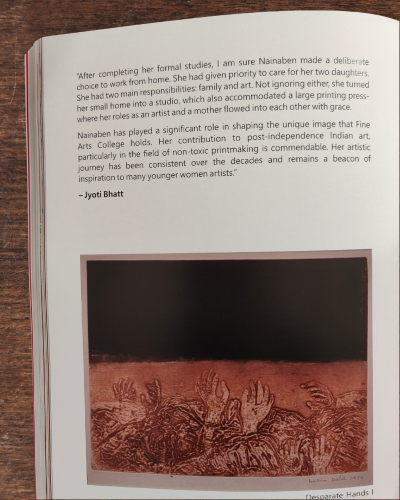
Image from the Book : Naina Dalal Seven decades in Image and Imagination
“After completing her formal studies, I am sure Nainaben made a deliberate choice to work from home. She had given priority to care for her two daughters. She had two main responsibilities: family and art. Not ignoring either, she turned her small home into a studio, which also accommodated a large printing press, where her roles as an artist and a mother flowed into each other with grace.
Nainaben has played a significant role in shaping the unique image that the Fine Arts College holds. Her contribution to post-independence Indian art, particularly in the field of non-toxic printmaking, is commendable. Her artistic journey has been consistent over the decades and remains a beacon of inspiration to many younger women artists.”
~ Jyoti Bhatt
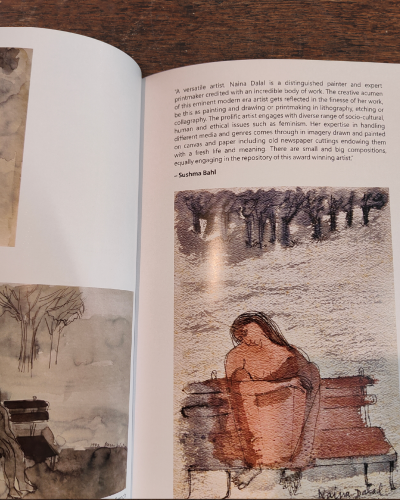
Image from the Book : Naina Dalal Seven decades in Image and Imagination
Sushma Bahl, writing on Dalal’s range, calls her “a distinguished painter and expert printmaker,” noting how her practice engages socio-cultural and ethical questions, including feminism. She writes:
“A versatile artist, Naina Dalal is a distinguished painter and expert printmaker credited with an incredible body of work. The creative acumen of this eminent modern era artist gets reflected in the finesse of her work be this as painting and drawing or printmaking in lithography, etching or collagraphy. The prolific artist engages with diverse range of socio-cultural, human and ethical issues such as feminism. Her expertise in handling different media and genres comes through in imagery drawn and painted on canvas and paper including old newspaper cuttings endowing them with a fresh life and meaning. There are small and big compositions, equally engaging in the repository of this award-winning artist.”
~Sushma Bahl
Artist Anupam Sud offers a beautifully direct observation about Dalal’s handling of colour, noting that she brings “the spirit of whatever you are doing”, a reminder that the emotional charge of Dalal’s work is not separate from her technique, but carried through it. In conversation with Naina Dalal, she says:
“I feel… honestly, if you hadn’t started printmaking, you would be a great watercolourist. I like the way you handle the colour. I just don’t feel that you are mastering the technique; I feel you are bringing in the spirit of whatever you are doing in your watercolour, which is beautiful.”
~ Anupam Sud
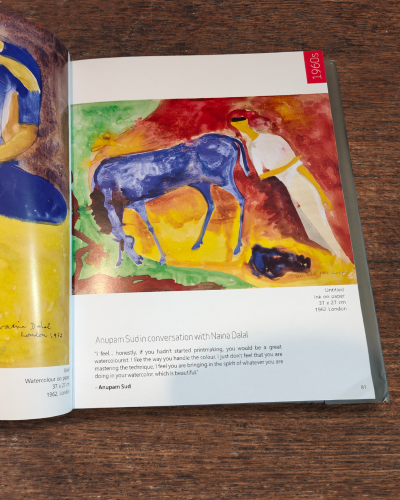
Image from the Book : Naina Dalal Seven decades in Image and Imagination
This is the purpose of the book, to hold Dalal’s life and work in one place, with the seriousness it deserves, and to offer readers a way to return to her images again and again, with deeper attention each time.
To purchase the book, enquire now.
News and updates
-
Kochi-Muziris Biennale: Collaterals announcement mentioning Gallerie Splash’s Dalal presentation
https://kochimuzirisbiennale.org/news/collaterals-kmb-announced- -
Times of India: Anupam Kher inaugurates parallel retrospectives at NGMA Mumbai
https://timesofindia.indiatimes.com/life-style/events/anupam-kher-inaugurates-parallel-retrospectives-of-padmashri-ratan-parimoo-naina-dalal-at-ngma/articleshow/123846807.cms -
Culture Crossroads: Report on the NGMA retrospectives
https://culturecrossroads.ca/posts/anupam-kher-inaugurates-parallel-retrospectives-of-padmashri-ratan-parimoo-naina-dalal-at-ngma/ -
Times of India: Baroda to Mumbai, two artists’ handprints on Indian modernism
https://timesofindia.indiatimes.com/city/mumbai/baroda-to-mumbai-two-artists-handprints-on-indian-modernism/articleshow/123885873.cms
India Today: Parallel visions, Naina Dalal and Ratan Parimoo
https://www.indiatoday.in/magazine/leisure/story/20251020-the-art-of-naina-dalal-ratan-parimoo-parallel-visions-2801147-2025-10-10




Leave a Comment