Prabhu Harsoor's practice unfolds as a layered field of image, mark, and memory in which the human
figure, the sign, and the spirit form coexist within a continuously shifting visual syntax. This exhibition
traces that evolution across decades, situating his work within a broader dialogue between...
Show More
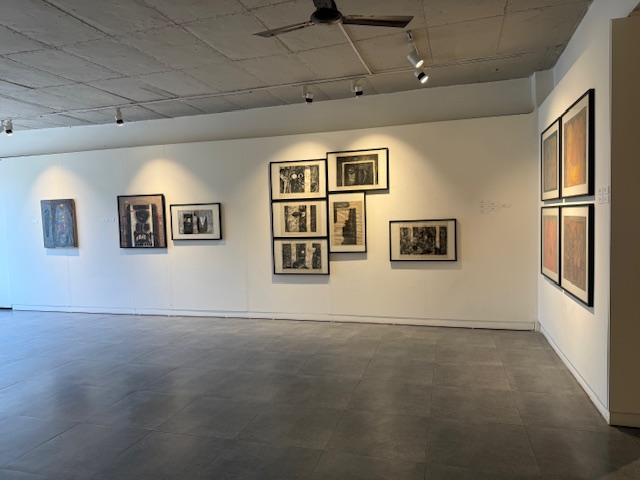
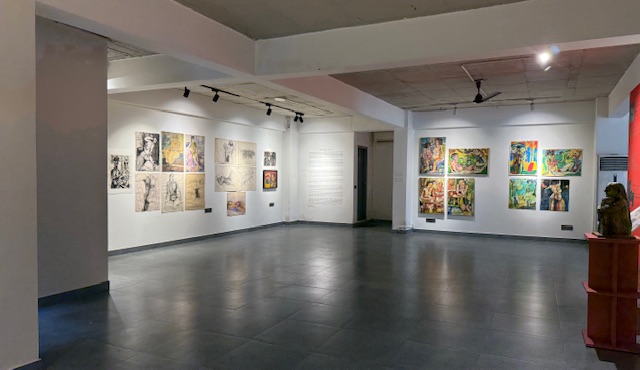
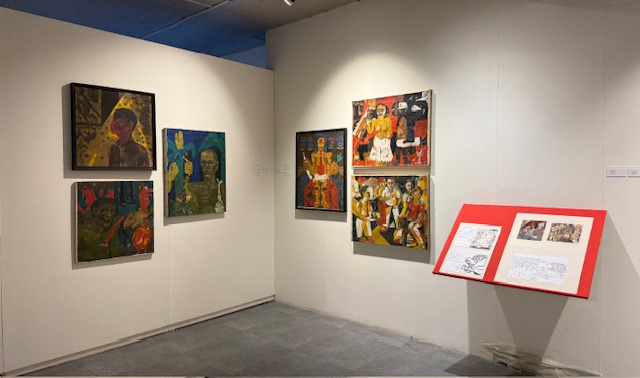
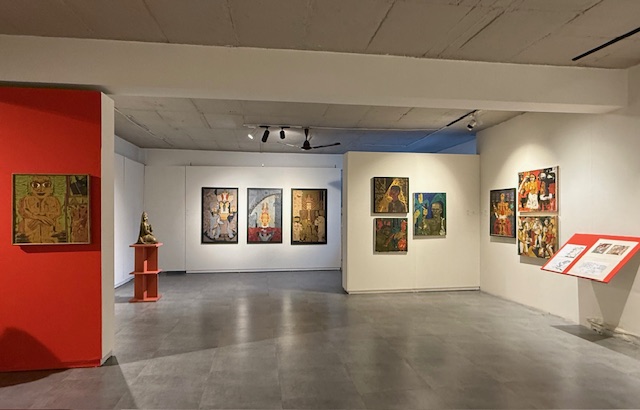
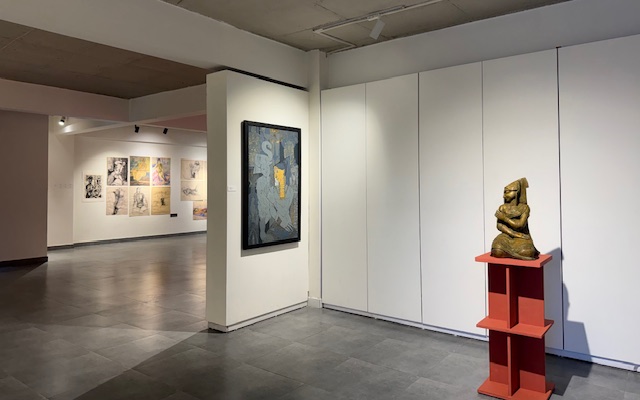
Prabhu Harsoor's practice unfolds as a layered field of image, mark, and memory in which the human
figure, the sign, and the spirit form coexist within a continuously shifting visual syntax. This exhibition
traces that evolution across decades, situating his work within a broader dialogue between European
modernist strategies and the vernacular, ritual, and symbolic vocabularies of South India. It proposes
not a linear movement from one tradition to another, but a sustained reconguration of both.
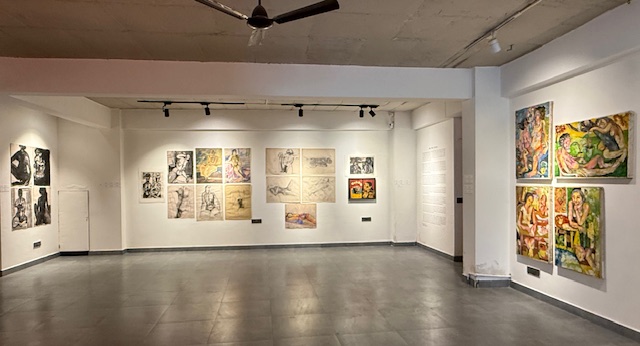
The early works reveal a rigorous engagement with academic realism. Figures are observed, studied,
and modelled with attention to weight, posture, and proportion. Yet even within these pedagogical
exercises, there is an emerging instability. Line resists containment and colour begins to detach from
descriptive function. What appears as discipline gradually opens toward fracture. The body elongates,
compresses,anddissolvesintoplanesofcolourandgesture.This moment aligns Harsoor with the project
of modernism, where the authority of the observed world is dismantled and reimagined.
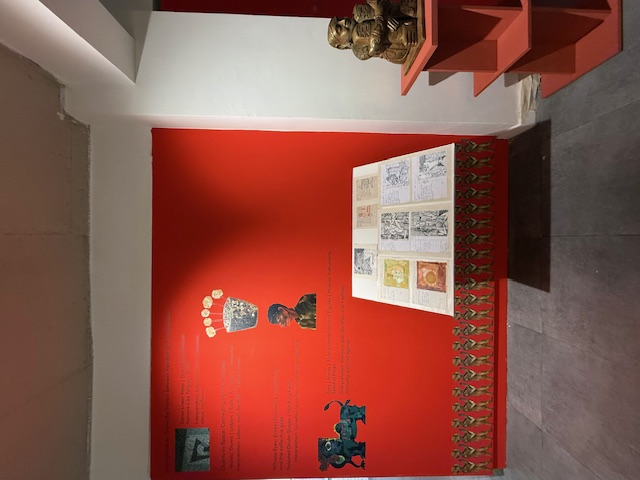
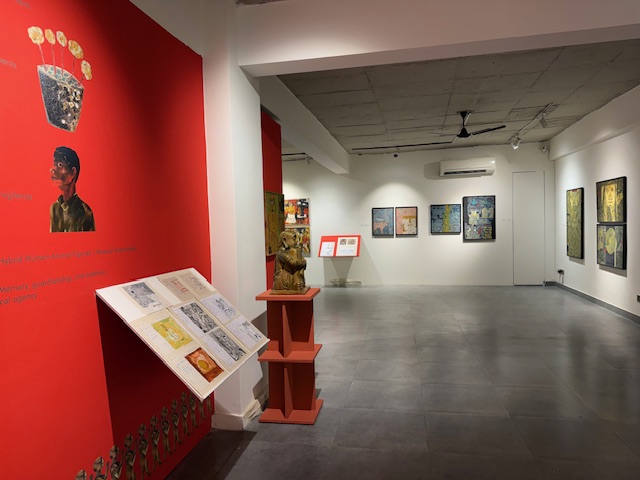
The shift that follows is not a return to representation, but a movement toward a different order of image
making. Drawing from temple iconography, inscriptional tablets, folk motifs, and the geometric logic of
the yantra, Harsoor constructs a pictorial language in which form operates as a diagram of thought rather
than a mirror of reality. As articulated in his visual syntax, the grid becomes a foundational structure, a
scaffold that recalls both architectural planning and the social matrix of lived experience. It functions
simultaneously as order and as resistance to order, bending under the pressure of improvisation and
memory.
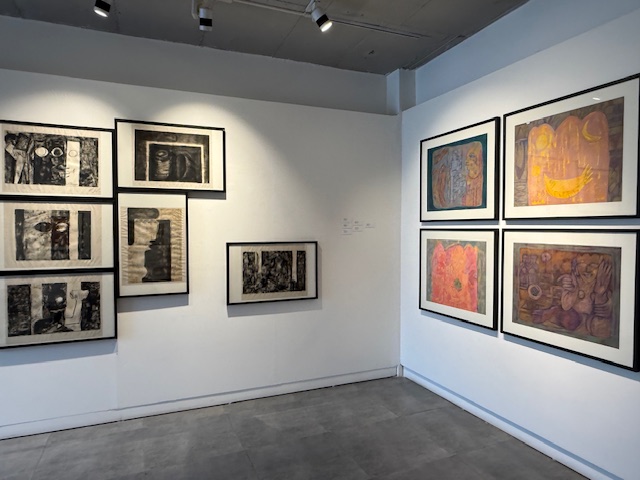
Within this mutable structure, glyphs emerge as carriers of cultural memory. These marks draw from
epigraphic traditions, kolam patterns, and non verbal systems of transmission. They operate as
language while insisting on opacity, echoing Édouard Glissant's assertion that meaning need not
always be fully legible. The image becomes a ?eld of encoded gestures rather than a fixed narrative.
The figure persists throughout this transformation, but it is no longer bound to naturalistic
description. It becomes a mask, witness, and presence. Faces split, multiply, and flatten into
emblematic forms.Repeatedeyessuggestbothsurveillanceanddarshan,invokingareciprocal act of seeing
that is at once sacred and social. These figures occupy what Homi Bhabha describes as a third space,
where identities are not fixed but continuously negotiated.
Animals, instruments, and hybrid forms further extend this field. They move from observed
companions to mythic agents, carrying memory, labour, and political resonance. The im ge expands
beyond the individual body into a broader constellation of relations. In this sense, Harsoor's work
enacts what Walter Benjamintermed now time,achargedconvergence inwhich pastand present are held
in simultaneous tension.
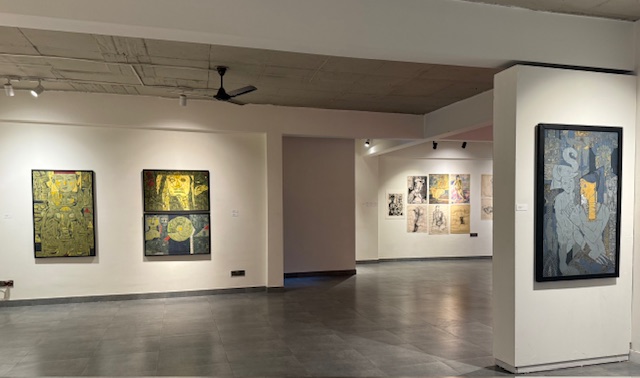
The mature works achieve a complex equilibrium. Modernist strategies of flattening, fragmentation,
and chromatic intensity remain visible, yet they are rearticulated through a distinctly local visual
intelligence. The result is neither synthesis nor juxtaposition, but a new pictorial logic in which myth,
mask, and modern operate as interdependent conditions. Harsoor's work insists that modernism
remains open, capable of being reconfigured through lived experience, cultural memory, and the
persistent act of making meaning.
-Satyajit Dave
Baroda, April 2026
Show less